Before the Chevrolet Silverado became a household name and a perennial best-seller, there was the C/K. Understanding the Chevy C/K Truck Predecessor History (Pre-Silverado) is like opening a time capsule to uncover the roots of America's enduring love affair with the pickup. These trucks didn't just haul lumber; they helped build the nation, defined generations, and set the stage for every modern pickup we see on the road today.
For enthusiasts, collectors, and anyone who appreciates a rugged workhorse with a story, the C/K lineage represents a golden era of American automotive design and innovation. While the Ford F-Series eventually claimed the top sales spot, the C/K trucks of the 1960s and 70s, especially, hold a revered place in popular culture and the hearts of millions.
At a Glance: Key Takeaways from Chevrolet's Pre-Silverado Era
- Early Innovators: Chevrolet was in the truck game early, debuting its first one-ton Model T truck in 1918, directly competing with Ford.
- The Dawn of Modern Pickups: The 1947 Advanced Design and 1955 Task Force lines were pivotal, introducing iconic styling and significant mechanical upgrades, including the legendary Small Block V8.
- C/K Naming Convention Arrives: The 1960 redesign marked the official birth of the "C" (two-wheel drive) and "K" (four-wheel drive) designations, paired with two-digit capacity numbers (10, 20, 30).
- Continuous Evolution: Each C/K generation (First Gen 1960-66, Second Gen 1967-72 "Action Line," Third Gen 1973-87 "Square Body," Fourth Gen 1988-2002 GMT400) brought significant advancements in suspension, engines, comfort, and safety.
- Legacy of Innovation: From independent front suspension to factory 4x4, crew cabs, and modern comfort features, the C/K series consistently pushed the boundaries of what a pickup truck could be.
- The Silverado Transition: The C/K nameplate eventually gave way to the Silverado in 1999 (GMT800 platform), though the GMT400 "old body style" trucks continued in some forms until 2002.
The Seed of a Legend: Chevrolet's Earliest Truck Roots
Before the familiar C/K badges graced Chevrolet's fenders, the company was already building a reputation for durable, practical work vehicles. This foundational period laid the groundwork for everything that followed, proving Chevrolet's commitment to the utility vehicle market.
Entering the Fray: The 1918 Model T
It all started in 1918 when Chevrolet made its formal entry into the commercial vehicle market with its one-ton truck, creatively named the Model T. This wasn't a coincidence; it was a direct response to the success of Ford's Model TT, signaling Chevrolet's intent to compete fiercely for the nascent truck buyer's dollar. These early trucks were rudimentary by today's standards, often sold as a chassis and cowl, leaving the customer to fit their own bed or body. They were pure workhorses, designed for hauling and little else, but they proved there was a market hungry for dependable utility.
Refining the Design: The AK Series and Advanced Design Era
Fast forward to 1941, and Chevrolet introduced the AK Series truck. While World War II soon shifted manufacturing priorities, the AK series represented a step towards more integrated and styled truck bodies. However, the real game-changer arrived post-war with the 1947 Advanced Design series.
These trucks were revolutionary. With their sleek, rounded styling, larger cabs, and improved visibility, they looked significantly more modern than their predecessors. They weren't just about looks, though. Underneath, improvements in comfort and utility made them far more user-friendly. The Advanced Design trucks quickly became iconic, symbolizing post-war American optimism and productivity. They're still highly sought after by collectors today, a testament to their timeless appeal.
Task Force Era: The Birth of Model Numbers and the Small Block
The mid-1950s brought another seismic shift with the 1955 Task Force line. This era is particularly significant for several reasons:
- Standardized Naming: Chevrolet introduced a more systematic naming convention using four-digit model names, such as the 3100 for the popular half-ton pickup. This system began to establish the hierarchy that would evolve into the C/K designation.
- Styling Evolution: The 1955 model year itself was split. The 1st Series carried over the Advanced Design aesthetic, while the 1955 2nd Series introduced a completely new design. This included a distinctive wrap-around windshield and a more aggressive, modern stance that foreshadowed the trucks of the 1960s.
- Power Play: Perhaps most importantly, the 1955 2nd Series offered the optional 265ci Small Block V8 engine. This engine would become one of the most celebrated and enduring powerplants in automotive history, forever changing the performance landscape for trucks. Its availability in the Task Force trucks meant that owners no longer had to choose between utility and power.
The C/K Takes Shape: First Generation (1960-1966)
The 1960 model year truly ushered in the C/K era as we know it. Chevrolet didn't just refine; they reinvented. This generation was a monumental leap forward in truck design, focusing on improved ride quality, accessibility, and versatility.
A Groundbreaking Redesign
The 1960 redesign introduced an all-new frame with a dropped center section. This innovation allowed for a lower cab floor, making it easier for drivers to enter and exit, all without sacrificing crucial ground clearance. It was a thoughtful design choice that balanced practicality with capability.
Ride Like a Car, Work Like a Truck: Suspension Innovations
This generation saw dramatic improvements in ride quality. Chevrolet equipped the trucks with an independent front suspension, replacing the traditional solid axle setup, which significantly enhanced comfort and handling. For the rear, coil springs with control arms were used, further smoothing out the ride. (Interestingly, GMC versions of these trucks often stuck with leaf springs for the rear, catering to a slightly more work-oriented buyer).
Early models (1960-1962) utilized a torsion bar front suspension, which provided a surprisingly smooth ride for the time. By 1963, Chevrolet upgraded to a more conventional coil spring front suspension, which remained through 1966.
4x4 Arrives: Go Anywhere Capability
The 1960 models also marked the official debut of a factory four-wheel-drive option. Unlike earlier conversions, this was a fully integrated system, utilizing a "divorced" transfer case separate from the transmission. This innovation immediately expanded the C/K's appeal, making it a viable option for off-road work, recreational use, and navigating challenging terrain.
The Naming Convention You Know
This is where the C/K legend truly solidified. The 1960 models introduced the familiar "C" for two-wheel drive and "K" for four-wheel drive designations. This was paired with a two-digit number to denote payload capacity:
- 10: Half-ton
- 20: Three-quarter ton
- 30: One-ton
GMC quickly adopted this logical and intuitive system, solidifying it across the GM truck lineup.
Fleetside, Stepside, and Distinctive Badging
Customers could choose between two primary bed styles: the smooth-sided "Fleetside" (which GMC called "Wideside") for a cleaner, more car-like look, or the utilitarian "Stepside" (GMC's "Fenderside") with its external fenders and handy side steps.
Chevrolet also used evocative names for its truck series based on their capacity:
- Series 10-40: "Apache"
- Series 50-60: "Viking"
- Series 70-90: "Spartan"
These names added character and a sense of rugged identity to the trucks.
Mid-Cycle Updates and Power Boost
In 1964, the C/K received a styling refresh, most notably changing to a flat windshield design, departing from the earlier wrap-around glass. This provided a cleaner look and improved aerodynamics. By 1966, Chevrolet sweetened the pot with the introduction of the powerful 327ci V8 engine and the smooth-shifting Turbo-Hydramatic (TH) transmission, further enhancing the trucks' performance and drivability.
The "Action Line": Second Generation (1967-1972)
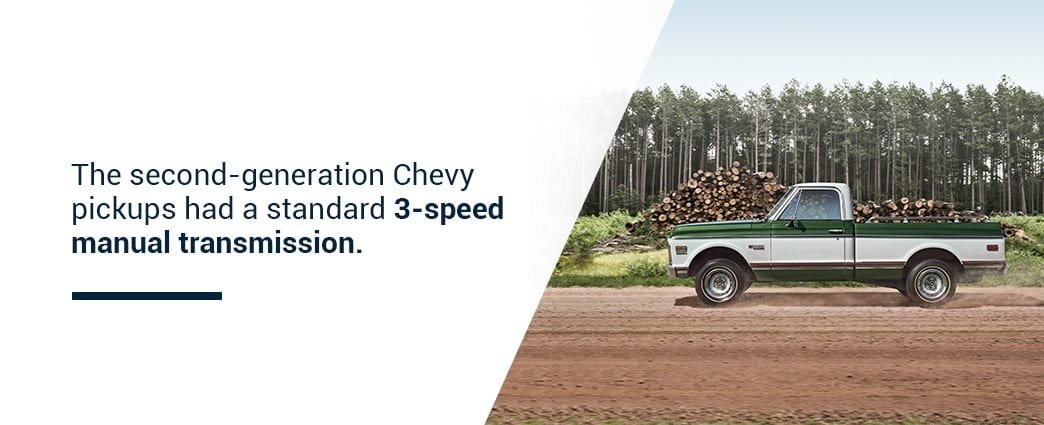
Often referred to by enthusiasts as the "Action Line" due to Chevrolet's marketing at the time, the second-generation C/K trucks are arguably the most beloved among collectors and restorers. They perfected the blend of classic truck utility with growing demands for comfort and style.
Refined Chassis and More Power
Chevrolet continued to refine the chassis and suspension from the previous generation, improving the overall driving experience. The powerful 327 CID V8, introduced late in the first generation, was a popular option, giving these trucks plenty of muscle for work or play.
Integrated 4x4 and All-Leaf Springs
The 1967-1972 4x4 models saw a significant improvement: the transfer case was now mounted directly to the transmission. This "married" setup increased ground clearance, making K-series trucks even more capable off-road. All 4WD trucks in this generation featured robust leaf springs on both the front and rear axles, a testament to their focus on durability and load-bearing capability.
Distinctive Grille Revisions
Each year brought subtle but distinct styling cues, particularly in the grille.
- The 1969 model featured a singular horizontal bar with integrated turn signals.
- By 1971, the grille evolved into a more intricate egg-crate design, with the turn signals neatly relocated to the bumper.
- GMC versions, ever keen to differentiate, typically sported a unique crosshair grille paired with quad headlights, giving them a more upscale appearance.
The Birth of Iconic SUVs: K5 Blazer and Jimmy
1969 was a landmark year for the C/K platform with the debut of the K5 Blazer. Built on a shortened C10 chassis, the Blazer offered a more compact, open-air SUV experience. Its versatility, with removable tops, quickly made it a hit. GMC followed suit with its own version, the Jimmy, providing a formidable competitor in the burgeoning SUV market.
Noteworthy Year-Specific Details
- 1967: This was the last model year for Chevrolet trucks without mandated side markers, giving it a particularly clean aesthetic favored by some purists.
- 1968: Chevrolet celebrated its 50th Anniversary with special packages. This year also saw the introduction of the unique Longhorn 3/4 ton trucks, which featured an extra 6 inches in the bed, primarily designed for mounting larger campers.
- 1970: The popular 396ci V8 engine was actually enlarged to 402ci this year but, for marketing consistency, continued to be sold under the "396" badge.
- 1971: A big year for comfort and safety. The luxurious Cheyenne comfort trim package (and GMC's Sierra package) debuted, offering car-like amenities inside a rugged truck. Crucially, front disc brakes became standard on all light-duty trucks, a major improvement in stopping power and safety.
The "Square Body" Legend: Third Generation (1973-1987)
The third-generation C/K, officially dubbed the "Rounded Line" by Chevrolet engineers due to its curved corners and subtle aerodynamic touches, became universally known by its more common and affectionate nickname: the "Square Body." Its angular, no-nonsense design defined the pickup truck aesthetic for over a decade and remains immensely popular.
Aerodynamics and All-New Design
Despite its blocky appearance, the "Square Body" was actually designed with aerodynamics in mind, tested in a wind tunnel. This was a sophisticated approach for a truck in the 1970s. The body was entirely new, yet clearly maintained the truck's utilitarian DNA.
Robust Chassis and Suspension Refinements
This generation rode on an all-new carbon steel ladder frame with a "drop center," providing a rigid foundation. Two-wheel-drive trucks continued with independent front suspension, offering a comfortable ride that was increasingly important as trucks began to double as daily drivers and family vehicles.
Smart Design: Fuel Tank and Body Styles
One notable safety and design improvement was the relocation of the fuel tank. It was moved outboard of the frame rails beneath the cab floor, a much safer position than previous in-cab tanks. This redesign also allowed for an impressive fuel capacity of up to 40 gallons on some models.
This generation also introduced a significant expansion of body styles:
- Crew Cab: The Crew Cab option debuted, offering true 3+3 seating (or ample interior storage), making the C/K a viable option for larger families or work crews.
- One-Ton Dually: The C30 one-ton dually, with its dual rear wheels, popularized the one-ton truck market, enabling heavier hauling and greater stability for commercial and serious recreational use. Dual rear wheel options were a game-changer for those needing maximum payload capacity.
Modern Comforts and Diesel Power
As trucks evolved from pure work vehicles to multi-purpose machines, so did their options.
- 1977 saw the introduction of optional power windows and locks, bringing car-like luxury to the truck cabin.
- 1978 was another milestone, with the first optional diesel engines appearing in C/K trucks, catering to buyers looking for improved fuel economy and torque for heavy towing.
The R/V Rebranding and Extended Life
By 1987, in anticipation of the upcoming GMT400 generation, Chevrolet temporarily renamed the C/K lineup to R/V (R for 2WD, V for 4WD). This helped differentiate the outgoing "Square Body" from the radically new trucks on the horizon. Despite the new generation's arrival, this incredibly popular body style had an extended life, continuing to be produced until 1991 for C30 Crew Cab trucks, the K5 Blazer, and Suburban SUVs, a testament to its enduring appeal and utility.
The Modern Era Begins: Fourth Generation (1988-2002 GMT400 / "OBS")
The fourth generation, known internally as the GMT400 platform and affectionately called "OBS" (Old Body Style) by enthusiasts today, represented a monumental shift. It brought trucks into the modern era of aerodynamics, advanced engineering, and increased refinement, fundamentally reshaping expectations for pickup trucks.
A New Look, A New Naming Convention
The 1988 model year marked a complete break from the past, with a sleeker, more aerodynamic design. Along with the new body came a revised naming system. Chevrolet reverted to four-digit names that are still familiar today:
- 1500: Half-ton
- 2500: Three-quarter ton
- 3500: One-ton
This simplified, capacity-based naming would carry forward into the Silverado era.
Universal Independent Front Suspension
One of the most significant engineering changes was the adoption of independent front suspension for all trucks, including 4WD models. This decision greatly improved ride quality and handling across the entire lineup, making even the most rugged K-series trucks surprisingly comfortable for daily driving.
Expanding Options: Extended Cab and Performance
The GMT400 platform was designed to be versatile. It introduced an extended cab body style, offering more interior room behind the front seats for passengers or gear, a crucial step toward making trucks more family-friendly.
This generation also saw the debut of some iconic packages and models:
- Z71 Off-Road Package: This popular package, still offered today, equipped K-series trucks with upgraded suspension, skid plates, and other off-road enhancements, cementing their capability for adventure.
- 454SS Performance Model: From 1990-1993, Chevrolet offered the beastly 454SS. This performance pickup packed a potent 454ci V8, sport suspension, and quick-ratio steering, proving that trucks could be just as thrilling as muscle cars.
Engine Evolution and Safety Enhancements
Engine options continued to expand and improve. A turbo-diesel engine became available in 1992, offering robust towing power and improved fuel efficiency. By 1995, the revered Vortec V8s debuted, featuring high-flow cylinder heads, new camshafts, roller valve lifters, and higher compression, all contributing to significantly increased power and efficiency.
Mid-cycle updates kept the GMT400 fresh and competitive:
- 1994: A refreshed front grille gave the trucks an updated look.
- 1995: A more comprehensive mid-cycle refresh incorporated federally mandated safety equipment, including a center high-mount stoplight and four-wheel ABS, emphasizing safety for occupants.
The C/K's Grand Finale and Silverado's Dawn
The GMT400 platform marked the final chapter for the C/K nameplate. It was replaced by the Chevrolet Silverado and GMC Sierra (built on the GMT800 platform) for light-duty trucks in 1999 for the 2000 model year. However, the venerable "Old Body Style" GMT400 trucks didn't vanish entirely overnight. They continued to be produced for three-quarter and one-ton fleet models until 2002, proving their enduring utility and value to commercial buyers.
Where the C/K Legacy Led: The Silverado Era (Briefly)
While the C/K name faded, its spirit lived on directly in the Chevrolet Silverado. The transition wasn't just a rebranding; it was an evolution that continued Chevrolet's relentless pursuit of better, stronger, and more refined trucks.
GMT800 (1999-2006): The First Silverado
The 1999 model year saw the official dropping of the "C/K" designations in favor of "Silverado" for Chevrolet and "Sierra" for GMC. These "New Body Style" (NBS) GMT800 trucks brought a fresh design, refined interiors, and a new generation of powerful Vortec engines. Innovations continued, with features like Quadrasteer 4-wheel steering offered on 2001-2005 Denali models, and high-performance Silverado SS and Intimidator SS variants. Even a gasoline/electric hybrid option was offered from 2004, showcasing Chevrolet's drive towards efficiency. After 2007, outgoing GMT800 models were often sold as "Silverado Classic" to differentiate them from the next generation.
GMT900 (2007 onwards): Building on Excellence
The 2007 GMT900 platform further solidified the Silverado's reputation. These trucks were engineered for reliability, particularly for high-mileage business use. A strong focus on aerodynamic efficiency, with a sleek 57-degree windshield rake and tighter body panel gaps, improved fuel economy. Engines like the 5.3L and 6.0L V8s featured Active Fuel Management (AFM) to deactivate cylinders under light loads, another nod to efficiency. The chassis moved to a fully boxed frame, increasing torsional rigidity by a staggering 234%, while a wider track enhanced stability. The interiors were redesigned to be quieter, more spacious, and more refined, reflecting the truck's increasingly prominent role as a comfortable daily driver.
This continuous innovation, from the earliest Model T to the modern Silverado, directly stems from the foundational work and relentless development of the C/K series. Each generation of C/K trucks built upon the last, perfecting the formula and setting new standards for utility, comfort, and performance.
To fully appreciate how far Chevrolet's trucks have come, and the enduring impact of this lineage, it's worth exploring the subsequent chapters. Explore Chevy Silverado generations to see how the spirit of the C/K lives on and continues to evolve in today's best-selling trucks.
Your Next Steps: Connecting with Chevrolet's Legacy
The history of the Chevy C/K truck isn't just a list of dates and specifications; it's a narrative of innovation, resilience, and American spirit. Whether you're an aspiring restorer eyeing a '67 "Action Line," a collector seeking a pristine "Square Body," or simply someone who appreciates the journey of a brand, understanding this lineage enriches your connection to these iconic vehicles.
- Dive Deeper: Research specific years or models that catch your eye. Each generation has its unique quirks and devoted fan base.
- Connect with Communities: Online forums and local clubs dedicated to C/K trucks are treasure troves of information, tips, and camaraderie.
- Consider a Project: If you're hands-on, restoring a vintage C/K can be an incredibly rewarding experience, bringing a piece of history back to life.
- Appreciate the Evolution: The next time you see a modern Silverado, remember its ancestors. The comfort, power, and capability you enjoy today are a direct result of over a century of Chevrolet's commitment to building the best possible trucks, starting with those pioneering C/K models.
The C/K trucks are more than just metal and rubber; they are a testament to American ingenuity and the enduring appeal of a dependable, hardworking vehicle. Their story is far from over, as their legacy continues to influence and inspire.