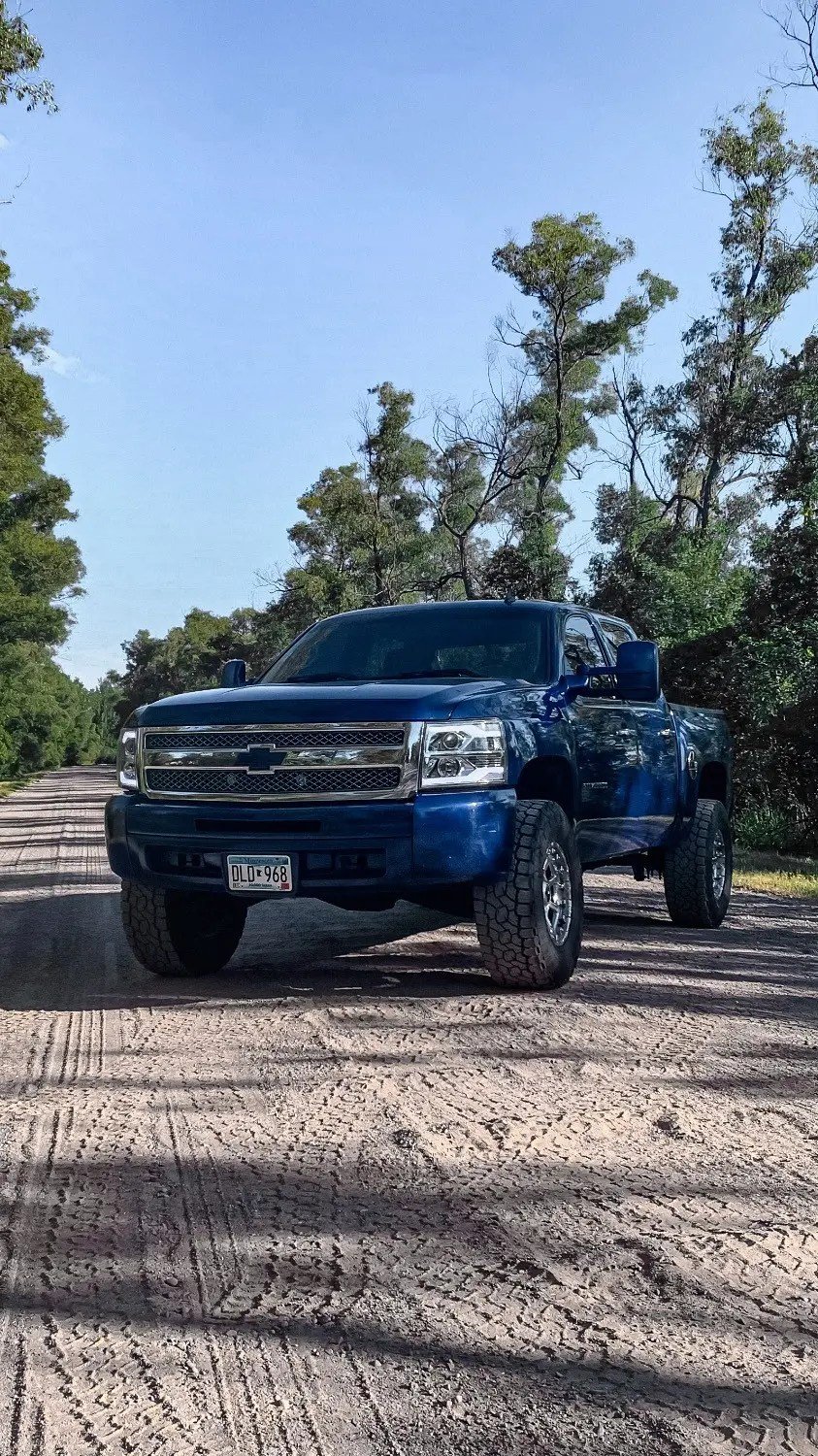
When the Second Generation Chevy Silverado (2007-2013) rolled onto dealer lots in the last quarter of 2006, it wasn't just another truck. It was a complete overhaul, a statement from Chevrolet that they weren't just participating in the full-size truck wars—they were aiming to win. And win they did, immediately snatching up both the North American Truck of the Year and Motor Trend's Truck of the Year awards for 2007.
This wasn't a minor refresh; it was a ground-up redesign. General Motors engineers reimagined everything from the chassis and suspension to the exterior styling and interior comfort, all while boosting engine performance and refining aerodynamics. The result? A truck that felt modern, capable, and surprisingly refined, setting a new benchmark for what a full-size pickup could be. If you're looking at a used truck today, this era of Silverado still stands as a testament to solid engineering and lasting value.
At a Glance: The 2007-2013 Silverado's Core Appeal
- Complete Redesign: Built on the robust GMT900 platform, it boasted a new frame, suspension, exterior, and interior.
- Award-Winning: Crowned "Truck of the Year" by multiple prestigious automotive outlets in its debut year.
- Engine Power-Up: Featured a shift to Generation IV small-block V8s, offering more power and efficiency, including Active Fuel Management (AFM) on many V8s.
- Versatile Configurations: Available in Regular, Extended, and Crew Cab layouts, with 2WD or 4WD, catering to a wide range of needs.
- Interior Choices: Offered distinct luxury-inspired and traditional dash designs, providing comfort or maximum utility.
- Heavy-Duty Enhancements: The 2011 HD models received significant upgrades for even greater capability and durability.
- Safety Improvements: Evolved from initial mixed safety ratings to "Acceptable" in key areas by 2010, with features like StabiliTrak and side airbags becoming standard.
A Fresh Foundation: What Made the GMT900 Different
Before the 2007 model year, the truck market was evolving rapidly, and Chevy needed to make a bold move. The outgoing GMT800 platform, while successful, was showing its age. Enter the GMT900, shared with its GMC Sierra twin, which fundamentally reshaped what drivers expected from a full-size Chevy truck.
This redesign wasn't merely cosmetic. The new frame provided increased rigidity, which translated directly into a more stable ride and better handling. The suspension was revised for a smoother, more controlled feel, whether you were cruising on the highway or navigating a bumpy job site. Aerodynamics were improved, too, contributing to better fuel efficiency and a quieter cabin—a significant advancement for a segment not always known for its slipperiness.
It's worth noting that for a brief period in 2007, you could still buy the previous generation as the "Classic" model. But the immediate success and accolades for the new Silverado quickly solidified its place as the superior choice, proving that Chevy had indeed hit a home run.
Tailored for Your Work and Life: Cab & Drivetrain Options
One of the Silverado's enduring strengths has always been its adaptability, and the second generation truly excelled here. Whatever your needs—from a basic work truck to a family hauler—there was a configuration designed for you.
You could choose from three primary cab styles:
- Two-door Regular Cabs: The classic, no-nonsense workhorse, ideal for individual tradespeople or those needing maximum bed length.
- Four-door Extended Cabs: Offered extra storage behind the front seats and occasional seating, with rear doors that notably opened 170 degrees for easy access to the back.
- Four-door Crew Cabs: The ultimate family or crew vehicle, providing ample rear legroom and four full-size doors, making it a popular choice for daily drivers and adventurers alike.
All these options were available in either two-wheel-drive (2WD) for better fuel economy and highway manners, or four-wheel-drive (4WD) for superior traction in challenging conditions. The 1500 models, in particular, benefited from front coil springs and rack-and-pinion power steering, which gave them a more car-like, responsive feel compared to some competitors, making daily driving more comfortable. Even the utilitarian Work Truck (WT) trim gained a crew cab option, broadening its appeal beyond just fleet buyers.
Under the Hood: Power and Efficiency Evolve
The heart of any truck is its engine, and the second-gen Silverado saw a significant shift from Generation III to the more advanced Generation IV small-block V8s. This upgrade brought not just more power but also improved efficiency, thanks in part to technologies like Active Fuel Management (AFM).
AFM, featured on the 5.3L and 6.0L V8s, allowed the engine to seamlessly switch between running on all eight cylinders and just four cylinders under light load conditions, saving fuel without the driver ever feeling a change. While AFM has been a point of discussion for some owners over the years regarding oil consumption, its intention was purely to make these powerful V8s more economical.
Here’s a look at the key engine options:
- 4.3L Vortec V6: The base engine, suitable for lighter duties and maximum fuel economy.
- 4.8L Vortec V8: A solid step up from the V6, offering more power for towing and hauling.
- 5.3L Vortec V8: The workhorse of the lineup, widely popular for its balance of power, towing capacity, and (with AFM) reasonable fuel economy.
- 6.0L Vortec V8: Offered even more grunt, especially in earlier models, before being largely supplanted by the 6.2L in later 1500 iterations.
- 6.2L Vortec V8: The undisputed powerhouse, initially exclusive to the 2007 Sierra Denali and Cadillac Escalade, where it churned out a potent 403 hp and 417 lb⋅ft of torque. It was paired with a sophisticated six-speed automatic transmission and, in the Denali, could sprint from 0–60 mph in a brisk 6.3 seconds. For the Silverado 1500, this beast became an option starting in MY 2009, making an already capable truck truly formidable.
Speaking of transmissions, a notable change during this generation was the phasing out of manual transmissions in U.S. and Canadian full-size trucks by 2008 (though the 4.3L V6 Silverado 1500 and 3500 still offered it in Mexico). Automatic transmissions evolved too, with the more efficient and capable six-speed automatics (like the 6L80 and 6L90) becoming more widespread throughout the lineup, replacing the older four-speed units.
The Silent Revolution: Silverado Hybrid (2009-2013)
In a forward-thinking move, Chevrolet introduced a two-mode hybrid Silverado in late 2008 as a 2009 model. This wasn't just a mild hybrid; it featured a sophisticated system pairing a 6.0-liter V8 engine (producing 332 hp and 367 lb-ft of torque) with two 60-kilowatt electric motors. The combined output was an impressive 379 hp.
This hybrid system utilized a nickel–metal hydride battery pack and a unique 2ML70 transmission/hybrid drive unit, allowing for electric-only propulsion at low speeds and significant fuel savings in city driving. Available exclusively as a Crew Cab in two- or four-wheel drive, it represented GM's push for more environmentally conscious options in the truck segment. Despite its technological prowess, the hybrid model was ultimately discontinued after the 2013 model year due to poor sales, perhaps a testament to the market's nascent readiness for hybrid trucks at the time.
Step Inside: Comfort Meets Capability
The interior of the second-gen Silverado was a substantial upgrade, offering a more refined and comfortable environment. Chevrolet understood that truck buyers had diverse needs, so they offered two distinct dash options:
- Luxury-Inspired Dash: Found in higher trims like LTZ and SLT (and the GMC Sierra SLT/Denali), this dash mirrored the upscale designs of GMT900 SUVs, featuring more flowing lines, improved materials, and often a large center console.
- Traditional Upright Dash: Available in lower trims, this more utilitarian design maintained a traditional upright look, allowing for a passenger seat instead of a center console, which was ideal for work crews or maximum seating capacity.
Beyond aesthetics, practicality was key. As the years progressed, the Silverado gained significant technology and convenience features. Bluetooth connectivity became available, allowing for hands-free calling, while an optional backup camera helped with parking and trailer hookups. An integrated trailer brake controller also became an option on 1500 series trucks, a crucial safety and convenience feature for anyone regularly towing. These touches made the Silverado not just a work vehicle, but a capable daily driver too.
Evolution Through the Years: Key Model Year Updates
While the core platform remained consistent, Chevrolet continually refined the Silverado through its production run, introducing enhancements that improved functionality, comfort, and aesthetics.
2009: Refinements and New Options
- Exterior Tweaks: All 1500 models received a revised bumper and a slightly shortened front fascia for a cleaner look.
- Transmission Expansion: Extended and crew cabs equipped with the Vortec 5300 V8 gained the new, more efficient six-speed 6L80 automatic transmission.
- More Power for All: The potent Vortec 6200 V8, previously exclusive or limited, became more widely available for Silverado LT/LTZ and Sierra SLE/SLT trims.
- Tech Upgrades: Bluetooth connectivity and an optional backup camera were introduced, bringing modern convenience to the cabin.
- Towing Advantage: An integrated trailer brake controller became an option on 1500 series trucks, a game-changer for safer towing.
- Efficiency Package: The XFE package (Xtra Fuel Economy) was introduced for Silverado 1500 Crew Cab LT 2WD models, featuring the 5.3L Vortec V8 with Active Fuel Management, a soft tonneau cover, aluminum wheels, and low rolling resistance tires.
2010: Interior Touches and Engine Consolidation
- Interior Refresh: New interior door panels provided an updated feel.
- Transmission Standard: The six-speed automatic transmission became standard on Regular Cab models equipped with the 5.3L V8.
- Engine Streamlining: The 6.2L V8 gained even wider availability, strategically replacing the light-duty Vortec 6000 V8 in many configurations, simplifying the powerful V8 offerings.
- Z71 Appearance: A new Z71 Appearance Package became optional on LT and LTZ trims, adding body-color elements and unique Z71 badging/instrumentation for a more rugged, stylized look.
- Color Palette: Two new exterior colors were introduced to the lineup.
2011: Heavy-Duty Models Get Serious
This year brought massive upgrades specifically for the Heavy-Duty (HD) models (2500HD and 3500HD), solidifying their capability for serious work.
- Super Strong Frame: HD models received a fully-boxed high-strength steel frame, boasting a 92% increase in stiffness.
- Enhanced Suspension: Bigger rear springs, larger engine/transmission mounts, and new hydraulic body mounts significantly improved ride quality and load handling. The front suspension was completely redesigned with new forged steel upper and cast iron lower control arms, and torsion bars precisely tailored to one of five gross axle weight ratings, allowing for an impressive 6,000-pound front axle rating on 4WD trucks—perfect for snowplows. The rear suspension switched to wider, asymmetrical leaf springs (3-inch-wide) to reduce axle hop. 2500HD models used a two-stage design (6,200 lb rating), while 3500HD models had a three-stage design (7,050 lb for single-wheel, 9,375 lb for dual-wheel).
- Denali HD: The upscale Denali trim became available for the GMC Sierra HD, bringing luxury to the heavy-duty segment.
- More Configurations: The 3500HD became available with the Crew Cab Standard Box configuration (single rear wheels) and a chassis-cab model with an extended 171.5-inch wheelbase crew cab, offering more options for commercial and specialized uses.
2012: Style and Safety for the Half-Ton
- 1500 Refresh: Silverado and Sierra 1500 models received another aesthetic refresh with new grille and front fascia treatments for LT and LTZ models, keeping them looking modern.
- Advanced Navigation: A redesigned touch-screen navigation radio was made optional on LTZ, SLT, and Denali trims, enhancing in-cabin technology.
- Standard Safety: Trailer sway control and hill start assist became standard across the 1500 lineup, improving safety and driver confidence when towing or on inclines.
- Interior Refinements: Cooled seats became optional on LTZ and SLT, while interior woodgrain trim was replaced with a more contemporary brushed aluminum look.
- Engine Changes (HD): The massive 8.1L big block V8 was no longer offered on Heavy-Duty models, with the Duramax diesel and 6.0L gas V8 continuing as primary options. The 6L90 6-speed automatic transmission became standard on all HD models, with the robust Allison 1000 transmission paired specifically with the optional Duramax turbo-diesel.
Your Peace of Mind: Safety Features and Ratings
When it comes to truck ownership, safety is paramount. The second-generation Silverado made strides in this area throughout its production. From the outset, it came standard with four-wheel anti-lock brakes (ABS). Electronic stability control, known as StabiliTrak, and side curtain airbags were initially optional on certain trims, becoming more widely available and eventually standard.
Initial safety ratings from the IIHS (Insurance Institute for Highway Safety) were mixed. The Silverado consistently received a "Good" rating in frontal crash tests, a testament to its strong front structure. However, 2007-09 models received a "Poor" rating in side impact tests. Recognizing this, GM strengthened the side structure and added side torso airbags, making side airbags standard for 2010. This crucial improvement boosted the IIHS side impact rating to an "Acceptable" level. Later, the 2011–13 Silverado crew cab received a "Marginal" rating in the IIHS roof strength test, highlighting an area where future generations would continue to improve.
Understanding these safety evolutions is key when considering a used Silverado from this generation, as later models offer enhanced occupant protection.
Why Own a Second Gen Silverado Today?
The 2007-2013 Silverado remains a highly popular choice on the used truck market, and for good reason. It hits a sweet spot of modern capability without the complexity (or price tag) of brand-new trucks.
Pros of the Second Gen Silverado:
- Durability and Longevity: These trucks are known for their robust build quality and long service life if properly maintained.
- Powerful V8 Engines: A range of strong V8 options provides ample power for towing, hauling, and daily driving.
- Versatility: With various cab, bed, and drivetrain configurations, there's a Silverado for nearly every need.
- Comfortable Ride: The GMT900 platform, with its coil springs and refined suspension, offered a noticeably smoother and more car-like ride than previous generations.
- Strong Aftermarket Support: Parts and accessories are plentiful and relatively affordable.
- Value: Offers a lot of truck for the money on the used market.
Considerations and Potential Pitfalls: - Active Fuel Management (AFM) Issues: Some 5.3L and 6.0L V8s with AFM can experience increased oil consumption or lifter problems. Look for service records.
- Rust: Like any truck, rust can be an issue, especially in colder climates where roads are salted. Pay attention to rocker panels, wheel arches, and the frame.
- Older Technology: While competent, the infotainment and safety tech isn't as advanced as modern trucks (e.g., no Apple CarPlay/Android Auto).
- Transmission Reliability: While generally good, ensure smooth shifting during a test drive, especially with higher mileage vehicles.
What to Look For When Buying: - Maintenance Records: Critical for understanding past issues and ensuring regular upkeep.
- Oil Consumption Check: Inquire about AFM-related oil consumption. A simple test is to check the oil level before and after a test drive.
- Rust Inspection: Thoroughly check the frame, body panels, and bed.
- Test Drive: Listen for unusual noises, feel for smooth transmission shifts, and test all 4WD functions if applicable.
- Recalls: Check the VIN for any outstanding recalls.
Choosing the right engine often comes down to your primary use case. If you're towing heavy loads regularly, aim for a 6.0L or 6.2L. For general use and decent fuel economy, the 5.3L is a fantastic all-rounder.
Future Forward (A Glimpse): The VIA VTrux
Even during its production run, the second-generation Silverado became a canvas for innovation beyond traditional gasoline power. In 2011, former GM vice chairman Bob Lutz joined VIA Motors with a vision to develop electric versions of the Chevrolet Silverado/GMC Sierra, branded as VIA VTrux. These plug-in hybrid electric trucks aimed to offer extended all-electric range for lighter duties, with the gasoline engine as a range extender for heavier work. While VIA Motors wasn't a mainstream success, it foreshadowed the electrified trucks we see hitting the market today.
The Silverado Legacy Continues
The Second Generation Chevy Silverado (2007-2013) truly earned its place in truck history. It wasn't just a popular choice for its time; it laid crucial groundwork for future generations, proving that a full-size truck could be simultaneously rugged, refined, and technologically advanced. It remains a compelling option for anyone seeking a capable, dependable, and value-rich truck today. To dive deeper into how this generation fits into the broader story of Chevy's iconic pickup, you can explore Chevy Silverado generations.